People ask me this in the first minute. Before the hide, before the price. How long does a bespoke leather jacket take. The honest answer is weeks, not days, and most visitors are surprised.
I am Marco Riva, third generation. My grandfather opened the workshop after the war, my father carried it on, I continue on Via del Proconsolo 5r. Below is the real timeline of a bespoke leather jacket florence order, from the day you walk in to the day you walk out wearing it, told the way it happens on the bench.
Why the honest answer is weeks, not days
Florence is full of leather. Markets, stalls, shop windows on every corner. Some of them will hand you a jacket the same afternoon. That jacket is not bespoke. It is stock, or it is altered ready-to-wear, and there is nothing wrong with buying it, as long as you know what it is.
A custom leather jacket italy artisans build by hand cannot be finished in a day, because three things inside it refuse to be rushed. A pattern has to be drawn from scratch on your body and then corrected. Leather is cut once and never twice, so it has to be read and rested before the knife touches it. Hand stitching takes hours a seam, and there are many seams.
Rush any of these and the jacket tells on you within a season. A shoulder that pulls. A sleeve that twists. A lining that lifts. Weeks buy fit and thirty years of wear. Days buy a garment that looks the part in the shop and fails on the road. If you want the deeper version of this, we wrote a whole piece on what changes between artisan and synthetic after ten years.
Week one: measurement and the conversation
It starts in the workshop, never over email. You come to Via del Proconsolo, in the heart of Florence, and I take the measurements myself. Eighteen of them for a jacket. Not the client at home with a tape and a mirror. The hand sees what the tape does not, the fall of a shoulder, the turn of an arm, the way you actually stand.
While I measure, we talk. What the jacket is for. How you dress around it. Where you will wear it. A jacket for cold mornings on a motorcycle is not a jacket for evenings in a city. A handmade leather jacket firenze masters build lives with one person, so I need to know that person before I cut anything.
This first hour is short but it decides everything downstream. Get the brief wrong and the fitting will not save it. This is also where I tell a few people, kindly, that bespoke is not for them, and send them to a good shop instead. It saves us both months. You can read how I think about the whole commission in our guide to how a bespoke leather atelier really works.
Weeks one to two: choosing the skin
The hide is half the jacket, so we choose it together, on the bench, with the whole skins in front of us. Not a swatch card. You touch them, fold them, hold them to the light. Lamb nappa for softness. Soft calf for structure. French calf when the colour has to sing.
I work with three tanneries I have known for decades. One in Tuscany, in Santa Croce sull'Arno, for vegetable-tanned hides. One in Italy for soft drum-dyed leather. One in France, in Aquitaine, for coloured calf. Hides arrive pre-selected for me, never pulled from a stock bin, and I still reject the ones with a weak spot or a mark that will not age well.
This stage overlaps with the pattern work, which is why I count it inside the first fortnight rather than after it. If you care how a Tuscan hide is actually made before it reaches my bench, we explained the whole process in how Florentine leather is made.
Weeks two to four: the pattern and the first cut
Now the slow work begins, out of sight. I build the pattern from your eighteen measurements. Paper first, then a toile, a cheap fabric that behaves like leather without the cost of a mistake. The pattern is where a made to measure leather jacket florence artisans cut becomes truly yours, and it is the part a same-day shop skips entirely.
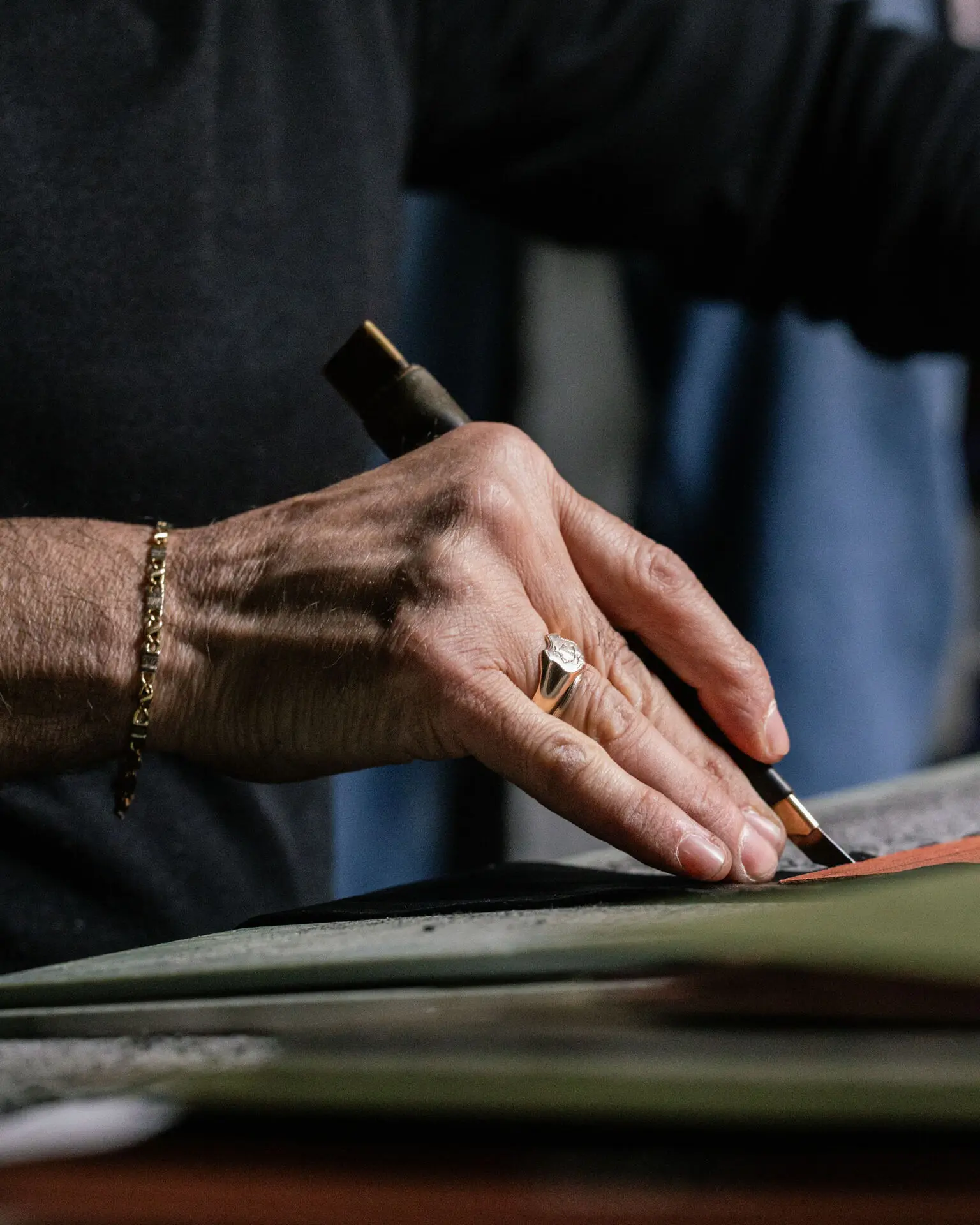
Then I cut. This is the moment I dislike hurrying most. Leather is not fabric. Each hide has a direction, a grain, a stretch that runs one way and not the other. I lay the pattern, read the skin, move the pieces to keep the best grain on the chest and the shoulders. When I am sure, I cut once. There is no second attempt on a first-cut hide.
Between cutting and stitching the pieces rest. Leather worked too fast, without rest, holds tension and warps later. So the bench sits. It looks like nothing is happening. Something is.
Weeks three to four: the fitting
Three to four weeks in, I call you back for the fitting. The jacket exists in toile now, stitched in the fabric mock-up, and you put it on in front of the mirror. This is where we correct. A shoulder a finger tighter. A sleeve a centimetre shorter. A pocket moved a thumb's width.
I mark it in chalk while it is on you, because a jacket read flat on the table lies. Most jackets need one fitting. A difficult figure, or a first client I am still learning, gets two. The fitting is not a formality. It is the single reason the finished leather falls right on the very first wear instead of after you have broken it in.
If you live far and cannot return, we do this by video call with the toile shipped to you, or we take the measurements while you are in Florence and finish after you leave. What we never do is delete the fitting to save a week.
Weeks four to ten: stitching, finishing, delivery
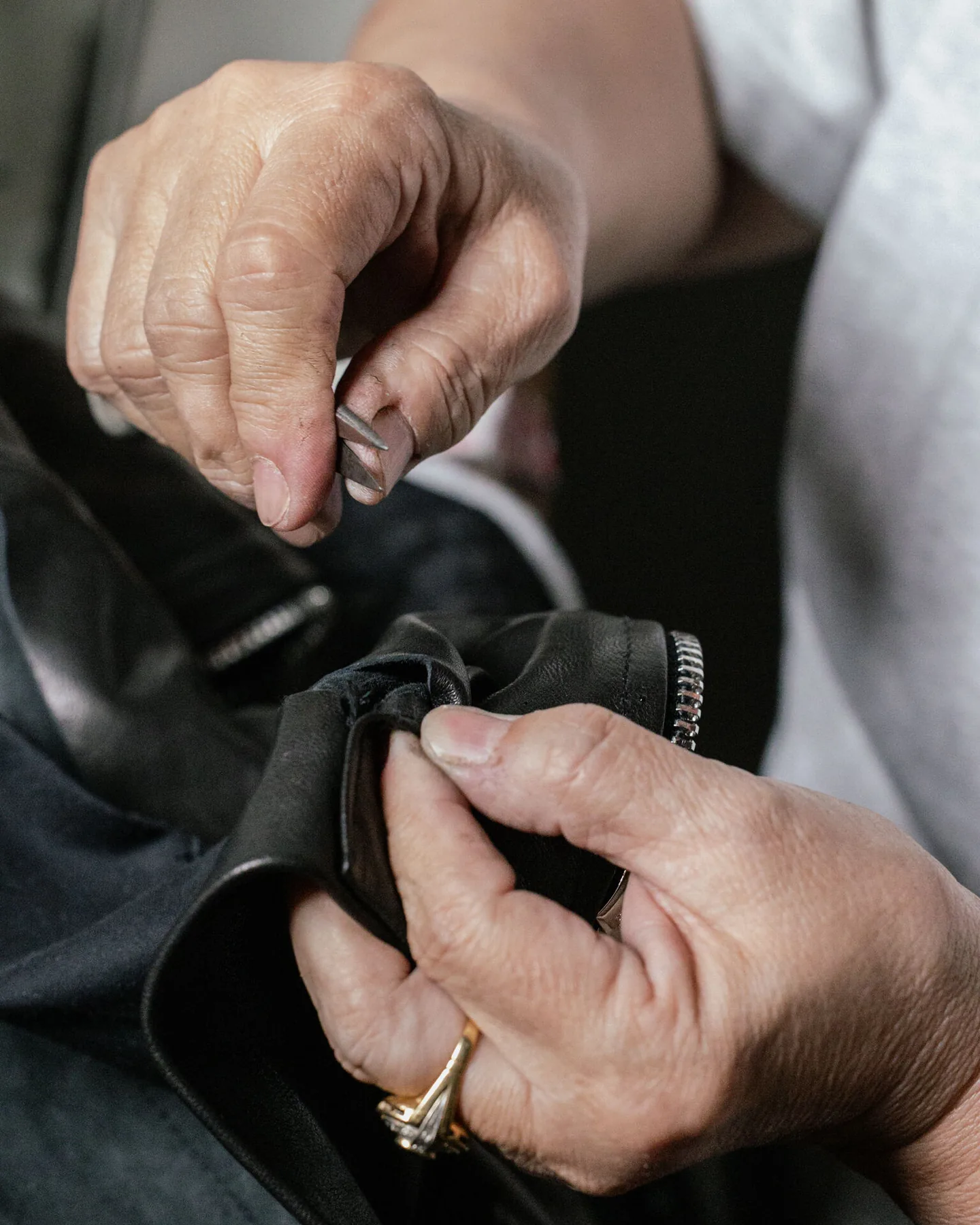
After the fitting I cut the real leather to the corrected pattern and stitch. Machine where a machine is stronger, by hand where the hand is finer, on the collar, the cuffs, the points that take strain. Hand stitching is slow by nature. There is no honest way to make it fast.
Then finishing. Edges burnished. Lining set. Buttons and hardware fitted and checked. The jacket rests again before it leaves. Around ten weeks from the first measurement for a men's jacket, eight for a women's, which is cut on the figure with darts the men's pattern does not carry.
Delivery happens in the workshop, not by courier if I can help it. You put the jacket on in front of me. We walk, we move the arms, we listen to whether the leather speaks right. If something is off, it goes back to the bench. I do not deliver a piece that does not convince me first. From the second commission the timeline drops to about seven weeks, because your pattern already exists and we keep it. If you want to see the models this timeline produces, they live in the collection and under bespoke.