A leather jacket in Florence should last twenty years. When it lasts one season, someone fooled you. The problem is not the price. It is the details few people know how to read. Real leather speaks. You only need to know what to listen for.
The three types of leather: full-grain, corrected grain, split
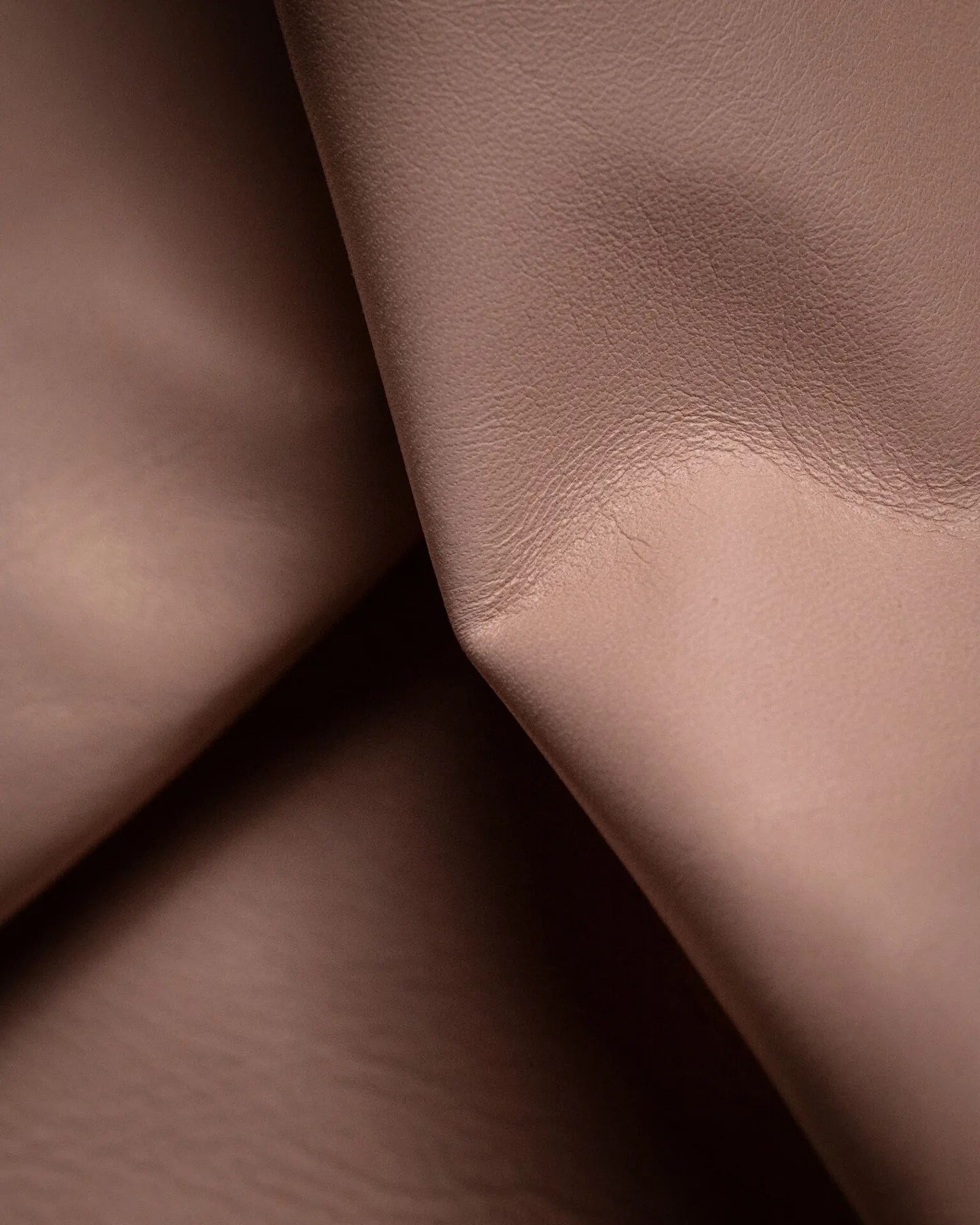
Leather is not one material. It has layers. The outer layer is called the grain. It is the most resistant part, the one that held the animal together for its entire life. Full-grain leather uses this layer intact. It is not sanded, not corrected. You can see the pores, the natural marks, the small imperfections. It is the best.
Corrected grain is the same layer, but sanded to remove imperfections. An artificial uniform grain is then printed on top. The leather loses breath and character. It cracks after two or three years of real use.
Split leather comes from the inner layers. It costs little and feels like leather at a quick touch, but it gives up fast. It is often coated in polyurethane to hide its fragility. When you see the words "genuine leather" on a label, you are usually looking at this.
A serious jacket starts with full-grain. Full stop. Everything else is a compromise the customer pays for without knowing.
The smell of real leather (and that of fake)
The smell tells you about the tanning. Tuscan vegetable tanning, made with chestnut and oak tannins, leaves a deep, slightly sweet scent that recalls old wood. It stays in the jacket for years. You notice it when you open your wardrobe.
Chrome tanning, faster and more industrial, has a sharper, almost chemical smell. It is not necessarily wrong for certain products. But on a fine jacket we prefer vegetable, or a balanced vegetable-chrome mix.
Fake leather smells of plastic. Sometimes of glue. Sometimes of nothing. If you smell a jacket and feel nothing, something is wrong. A living leather always has a smell.
The edges: hand-cut vs printed
Look at the edge of a sleeve, the hem, the collar. On a well-made jacket the edge is cut clean, then dyed by hand with care. Sometimes it is slightly irregular, because a hand is not a machine. That is a good sign.
On industrial pieces the edge is heat-sealed or stamped with a plastic-coated tape. It has that fake shine that peels off after a few rains. Run your finger over it. If you feel an unnatural thickness, a line too perfect to be true, you are facing a shortcut.
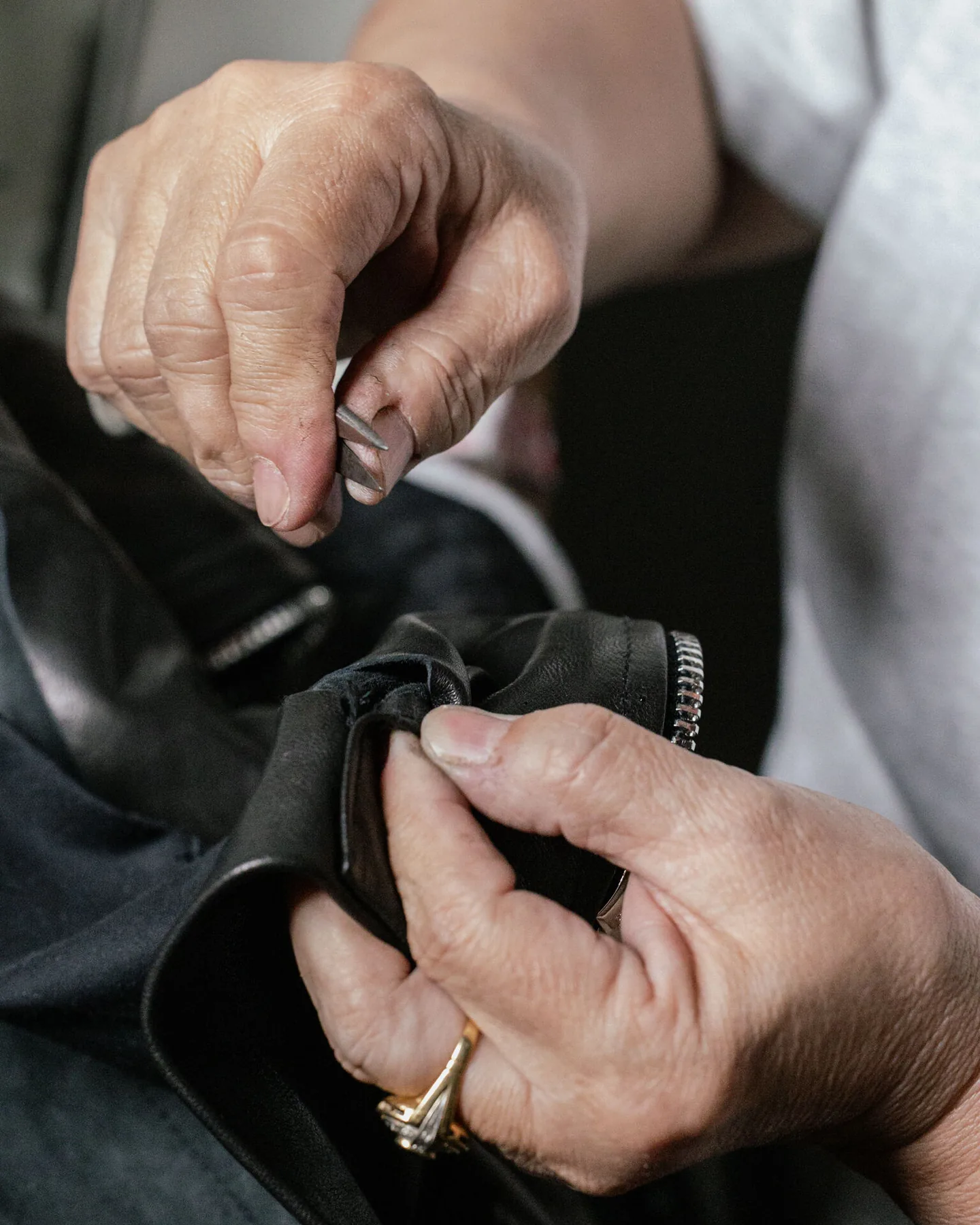
On bespoke jackets the edge is finished one piece at a time. This alone changes how long the garment lasts. Our bespoke work always starts here: cuts, edges, finishes done by hand.
The stitching: stitch, density, finish
A well-made seam has three qualities. Regular stitch, right density, clean finish. A regular stitch means the distance between one stitch and the next stays constant. The right density sits between five and seven stitches per centimetre on a classic jacket. Too loose means haste, too tight means a machine that forced the material.
The finish shows at direction changes. On the lapels, under the sleeves, around the pockets. On a serious jacket the thread does not escape, does not slip, does not leave visible tails. On a bad jacket you find knots in plain sight, threads cut halfway, seams already loosening.
A leather jacket carries between twenty and thirty kilometres of total stitching. If even one section is done badly, that is where it falls apart.
The label: what to look for and what to mistrust
The label should say three things. The type of leather, the origin, the maker. When you only see the word "leather" with no other detail, suspect it. When you see "genuine leather" or "bonded leather", run: the first phrase is marketing code for split leather, the second is reconstituted leather, that is, scraps glued together.
Look for full-grain. Look for the tannery name, if possible. Serious Tuscan tanneries sign their hides. Our valley, Santa Croce sull'Arno and the towns around it, has been tanning leather since before Italy was united.
Mistrust labels with Italian flags printed but no address. Mistrust the wording "design Italy". Made in Italy is one thing, design Italy another: the design can be Italian and the production Chinese.
Made in Italy: what it really means for leather
To honestly say Made in Italy leather, two operations must happen here: the tanning and the sewing. When both stay in Italy, the jacket has real roots. When only one stays here, we are talking about a piece finished in Italy but not born here.
The Tuscan chain is one of the last in the world where hide, tanning and tailoring sit within a hundred kilometres of each other. From us in Florence, the leather comes from Santa Croce or Ponte a Egola. We sew it here, in the atelier, above the shop. Our collection is born less than an hour by car from the tanneries that supply it.
This is not romance. It is the reason certain jackets last a generation.
Real prices (and why 200 euros is not enough)
A real leather jacket, full-grain, sewn in Italy, starts at around seven hundred euros. This is not an opinion, it is a calculation. The raw hide costs, the tanning costs, the cutting costs, the sewing hours cost.
Below four hundred euros, on a jacket sold as real leather in Florence, something in the chain has been cut. Often it is the leather: split instead of full-grain. Sometimes it is the making: sewn in Asia, finished badly, resold as Italian.
A bespoke jacket, the Firenze model for men or built on the figure for women, sits between one thousand and two thousand euros. It costs more because we keep it for two or three fittings, because a whole hide is chosen for a single piece, because the inner seams are finished by hand. It costs less, in the end, because it lasts twenty years.
Five questions to ask the seller
When you walk into a leather shop in Florence and they offer you a jacket, these five questions filter out ninety percent of the problem.
- Which tannery does the leather come from? A serious seller can answer. A reseller of industrial pieces cannot.
- Is it full-grain? If the answer is "it is real leather", press them. Real leather means nothing.
- Where is it sewn? If the answer is vague, that is a sign. If they show you the workshop or describe it in detail, you are in the right place.
- Can I see the back of the lining? Inner seams tell the truth that outer ones hide.
- What happens if the leather gets damaged in five years? A real atelier knows how to repair the garment it made. A reseller does not have that option.
Marco Riva, third generation, signs almost every jacket that leaves our workshop. We recognise them years later, when they come back for a repair or a new piece. A leather jacket, chosen well, accompanies a whole life. It is worth spending forty minutes to understand it before buying it.