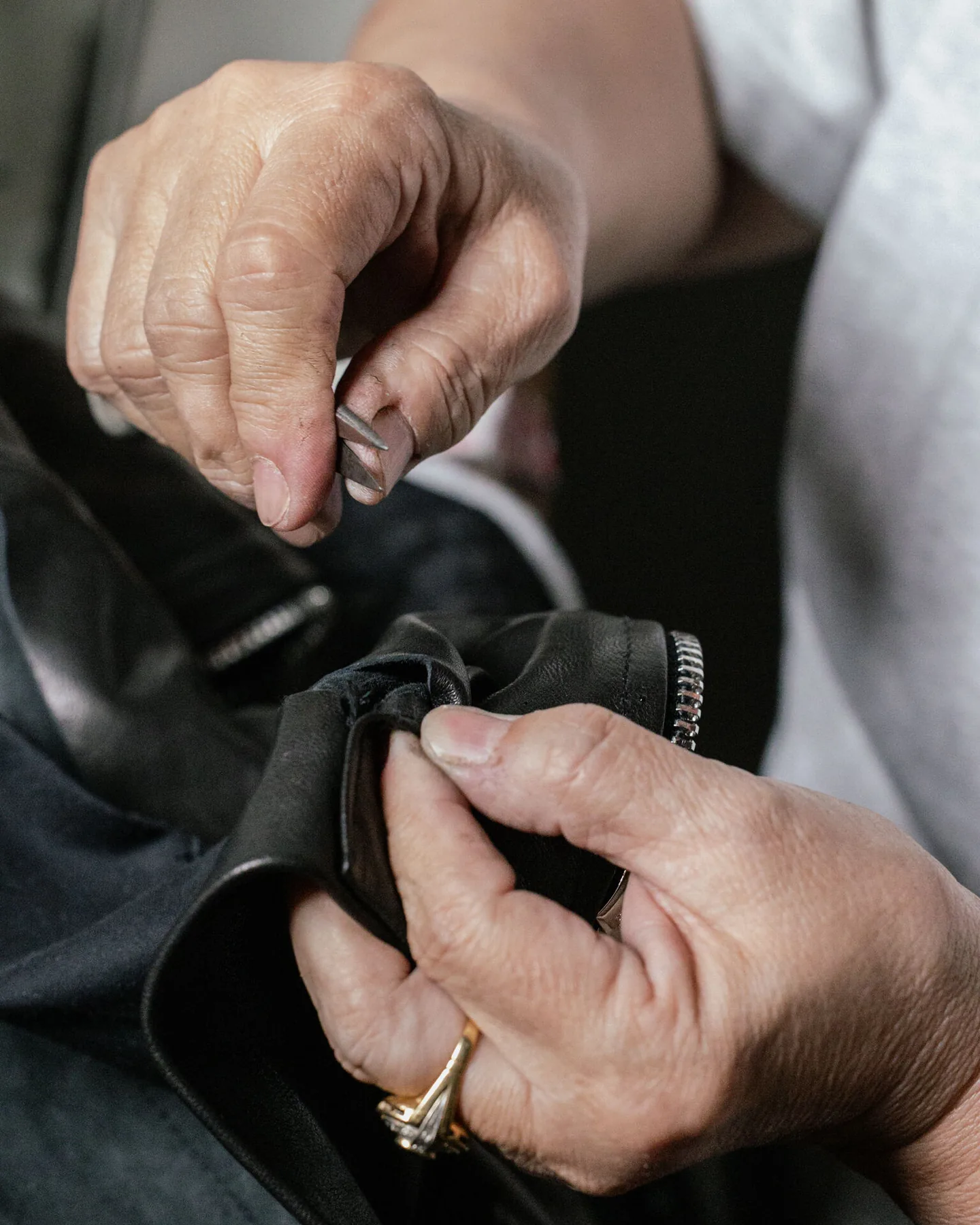
Every year jackets come back to our atelier after twenty or thirty years of wear. Some were stitched by our grandfather. We restore them, replace the lining, refresh the tanning. They go back on. In the same period we have watched hundreds of synthetic garments, bought at a third of the price, disappear. They cannot be repaired. They get thrown away.
This article lines up the numbers. No artisan romance. Just what happens to artisan leather and synthetic year after year, until the breaking point.
What happens after 1 year
The first year separates little. A new synthetic jacket shines, holds its factory colour, looks in shape. Artisan leather after the first winter shows only the marks of whoever wears it: the collar starts folding along the shoulder line, the cuffs darken at the friction points.
Synthetic, on the surface, loses light gradually. The polyurethane fibres absorb micro-tears invisible to the naked eye. The first internal cracks appear inside the cuffs and under the collar, where the fabric fold works with every movement.
Tuscan vegetable tanning, in twelve months, has begun breathing its future. It is calibrating to the body of the person wearing it.
What happens after 3 years
At three years the difference is visible. Synthetic starts showing the loss of shape: the sleeves go limp, the polyester lining detaches from the seams at tension points, the pockets gleam unevenly. Five synthetic garments out of ten, after three years of regular wear, have moved from wardrobe to bin bag.
Vegetable tanned leather at three years has begun its real transformation. The surface darkened by half a tone where the sun found it most. The folds have settled on the figure. It is the early leather patina, the one many call a flaw and which is instead the first sign that the garment is working.
What happens after 5 years
Here the paths diverge sharply. Seven synthetic jackets out of ten, bought five years earlier, no longer exist. The ones left have permanent stains, deep cracks, torn linings. Repair costs almost as much as a new garment, and no honest tailor takes the job: the material does not hold a stitch.
A vegetable tanned leather jacket, after five years of real wear, has entered its best phase. Our men's Firenze jacket at five years shows a glowing chest, sleeves folded on the elbows as if sculpted. Marco calls it the moment when the jacket stops being new and starts being yours.
What happens after 10 years (the breaking point)
Ten years is the statistical breaking point. Out of one hundred synthetic garments sold ten years ago, fewer than five remain in use. The rest are in landfill or at the bottom of a wardrobe waiting to get there.
Out of one hundred vegetable tanned leather jackets that left our atelier ten years ago, we see about eighty come back. Some for restoration, others just for a check-up. They are jackets that have been to weddings, on journeys, at work daily. They have taken rain, sun, sweat, wine. They have become recognisable: those who wear them carry them like a second skin, and they essentially are.
A restoration at ten years costs, on average, between ten and fifteen per cent of the original price. The jacket leaves the bench good for another ten.
Patina vs decay: two opposite paths
The word patina is not marketing. It is a chemical fact. Vegetable tanned leather is living hide: the tannins extracted from chestnut, mimosa, oak keep reacting with air, light, the natural oils of whoever wears it. Year after year the surface becomes richer, darker at warm points, lighter at friction points. Leather patina is the memory of the garment.
Synthetic does the opposite. It does not live: it decomposes. Polyurethane, the most common imitation, has a chemical life expectancy of six to eight years even hanging in a closed wardrobe. It is called hydrolysis: air humidity breaks the molecules of the material. A fake leather jacket bought today and never worn will be brittle just the same in ten years.
One lives, the other expires.
The cost per year worn (cost per wear)
The cost per wear leather jacket figure tells the truth. You calculate it by dividing the price of the garment by the number of times it is worn.
A synthetic jacket at 250 euros, worn on average two seasons before breaking, gets about 120 wears. Cost per wear: 2.10 euros. Sounds low. It is, looking only at the number.
One of our vegetable tanned leather jackets, made to measure, starts at 1,800 euros. Worn for ten years, three times a week, in autumn and winter, that is about 1,250 wears. Cost per wear: 1.44 euros. Restored at ten years for 200 euros, extended another five, it drops below one euro.
Six times more expensive at purchase. Cheaper over time. Worth remembering when the initial price feels like the only metric.
The real environmental impact (the numbers)
The numbers on leather impact circulate widely, often wrong. Worth getting them right.
Tuscan vegetable tanning uses tannins extracted from wood scraps: chestnut and oak that would otherwise be sawmill waste. The tanning water, in serious operations of the Florentine district, is purified and reused in closed cycles. The hide itself is a by-product of the food industry: if not tanned, it would be incinerated.
A vegetable tanned leather jacket has a footprint of about 80-110 kg of CO₂ equivalent across its full life cycle, amortised over fifteen-twenty years of real use. That becomes around 5-7 kg of CO₂ per year worn.
A synthetic leather jacket costs the planet about 25-35 kg of CO₂ in production. Sounds less. It only is on the surface: it lasts a third of the time, and at end of life it does not biodegrade. It shatters into microplastics that stay in circulation for centuries. The bill per year worn rises to 8-15 kg, before counting the terminal damage.
The Tuscan approach to tanning is not perfect. It is measurable, regulated, traceable. Synthetic hides itself better.
When synthetic makes sense (yes, there is a case)
We would not be honest if we said leather beats synthetic everywhere. There are uses where synthetic wins.
Heavy rain technical gear, intensive sportswear, work equipment that must be machine washed, garments for very young children who will wear them six months: in all these cases modern synthetic does its job better than leather. It weighs less, dries, costs little, and its short life matches the short use planned.
What does not work is synthetic dressed as a garment for life. Fake leather sold as an ethical alternative to a real leather jacket, at the same price or close to it, is the actual deception. It is cheaper to produce, lasts less, and carries a higher total environmental cost.
For a hand-woven leather bag or a full-grain leather belt, objects you buy once and keep for thirty years, synthetic is the wrong choice. The numbers say so, not the romance.
Ten years is the time it takes to understand whether a garment was well made. What you buy today becomes what you wear in 2036. Worth choosing well.